Friday, December 10, 2010

Goin' social through song and axe

It's pouring rain in Matt Wilson's backyard.

About 40 people have come to battle the damp and chilly October night, all in the name of Wilson’s game: Backyard Axe Throwing League (B.A.T.L.).

Players step up to a stone plate, wield their individually painted hatchets behind their heads and aim for the bull’s-eye on a rectangular-shaped wood plank target 15 feet ahead.

“It’s satisfying as all hell; the sound it makes and the feeling you get when you throw it and it sticks in the bull’s-eye,” Wilson said. “Then you just want to throw five in a row.”

But not everyone has come to throw an axe. Half of the people there want the entertainment.

“It’s totally a social thing,“ Wilson said. “When you’re not playing, you’re hanging out and you’re watching and you’re cheering.”

A similar social element exists in Toronto’s do-it-yourself acappella singing group, Tunes Beats Awesome (TBA).

‘Have fun. Sing good.’ That’s TBA’s mantra.

Eight years ago when it began, Jeff Magee started singing with TBA; he’s since become co-director of the group.

Every Sunday, Magee drives from Pickering to the Hart House building at the University of Toronto campus to meet with the other 17 group members for rehearsal.

Magee conducts each rehearsal, coaching the singers and giving them feedback. When TBA performs at events such as Acappellooza - where they gave two sold-out shows last year - he joins the group on stage to provide the vocal percussion.

When they’re not rehearsing, Magee and co-director Katherine Dodds have their hands full running the group.

“TBA’s not just a Sunday-run group,” Magee said. “You have to be thinking about everything every single day.”

Printing off sheet music, booking gigs and directing their publicity keep Magee and Dodds occupied. Although Magee finds it tiring, the reaction he sees from the singers makes it all worthwhile.

“You get a lot back from it just seeing how much they enjoy it,” he said. “I wouldn’t put the effort in if I didn’t feel it was rewarding.”


Clips from B.A.T.L. featuring TBA's version of "Battlefield"

Wilson’s B.A.T.L. began while on a cottage trip in the summer of 2006. Wilson and his friends started throwing a hatchet into a tree to pass the time. They soon added rules and a point system. Five throws per player per round, three rounds per set. Players get five points for the bull’s-eye, three points in the ring around it and one point for the outer ring. The player with the most points wins the round as they play a best-of-three set.

When Wilson returned home from the cottage trip, he built the first B.A.T.L. target and convinced a dozen friends to contribute $25 for materials and to join the fun.

Since then, B.A.T.L. has continued to grow in popularity. This year has been particularly significant for Wilson.

“I took the plunge to make it two nights (per week) and did all of the legal stuff to make it completely legitimate,” he said. “I’m now treating it like something that I could do for a living, within the next year maybe.”

Wilson plans to eventually move the league indoors and run it year-round. He explained why he thinks the game attracts competitors.

“There’s an element for people who feel like they shouldn’t be allowed to do it,” he said. “You’re throwing an axe ... It sounds completely dangerous, but when you get back there and see it, it’s not at all; it’s totally organized.”

David Banerjee, a Toronto teacher with an MA in educational theory, explained why people engage in activities outside their daily work routine.

“We have a minimum amount of social intercourse that we need,” Banerjee said. “We are pleasure-seeking ... We like to be around each other. We’re evolved for tribal living and it’s nice to have fun.”

Banerjee added that people have been designed to find meaning in the world by doing something they enjoy.

“People structure their understanding of the world by saying, ‘I’m not really going to try and understand the world, I just want to understand my little piece of it ... and I’ll be pretty happy,’” he said.

Sharing that understanding with others appears to be a common theme for TBA and B.A.T.L. participants. Just like Wilson said, Magee finds value in the social aspect of acappella singing.

“Some of the best times we have are when we go to Michigan and meet other groups,” Magee said. “It’s like a family ... You’re all music nerds.”

Wednesday, December 8, 2010

Forget the drugmart and do-it-yourself

She digs two tablespoons of baking soda and glycerin; one tablespoon of cornstarch, pours it into a small bowl, adds a few drops of natural oils and grapefruit, and stirs the ingredients to a thick white paste. This is how Lisa Druchok makes deodorant.

“Over the past three years I have gained a real interest in learning how to make things myself,” Druchok said. “During the course of 2010 I have taken more do-it yourself workshops.”

Druchok is a client of Tracey TieF, a Natural Health Practitioner, who hosts hands-on workshops from her Toronto home for people seeking alternative methods to make health and cosmetic products.

Small jars and vials of natural herbs and oils sit in her small living room, where she instructs clients on making their own natural cosmetic products, such as fragrances, skin lotions and shampoos. She said she always had an interest in the natural means of treating the body.

“When I was four for instance my sister was suffering from asthma so I made her a ginger drink and as it turns out ginger is a helpful decongestant,” TieF said.

Prior to launching her wholistic health practice, Annares Natural Health in 2007 TieF worked with the homeless for 19 years and said she saw a link between the two.

“I’ve always been an activist so there is a deep connection for me between social justice and traditional ways of interacting with the environment and healing people,” she explains.

TieF uses essential oils on cosmetic products she makes and abstains from using preservatives. Clients sign up for her workshops for various reasons. Some are looking for different options, and others are interested in the actual process of making body care products.

Fleur McGregor visited a workshop to make a skin lotion for her baby.

“I had a desire to have (the skin lotion) be completely natural and under my control,” McGregor said. “It also sounded like fun to be able to find out how to make it.”

Vicky Yoo is a marketing assistant at Pure and Simple, a wholistic spa and a natural skin care products retailer. Yoo said more people are turning to natural alternatives, and this turn prompted companies to manufacture natural and organic cosmetic products.

“A lot of people get allergic reactions to skin care products and are looking for something more pure,” Yoo said. “So (cosmetic manufacturers) have to think of producing skin care lines that are more natural.”

TieF said the ingredients in her products are known as GRAS (Generally Regarded As Safe) by the Canadian Food Inspection Agency, and don’t require any testing. Cosmetic products that contain preservatives must meet the requirements of the Food and Drugs Act.

TieF said there is a list of substances banned from the market, but there have been no tests conducted to determine the safety of two or more combined substances.

Goin’ Solo Magazine tried to reach Health Canada’s Consumer Safety office but were unable to get a response.

As Druchok flips through her notes, pondering which elements she wants to put together for her next recipe, TieF walks into her kitchen and returns with a bottle of vodka.

Druchok mixes the vodka with coriander oil, cleaning vinegar, and then pours it into a small glass bottle to create an odour remover. Druchok said she feels that DIY workshops such as this are important and skepticism has driven her to take part in these workshops.

“I am always striving to be more self sufficient,” she explained. “It seems odd to me that people don’t know how to make the products or grow the food we have come to rely on.”

Wednesday, December 1, 2010

Toronto artists do it on the street


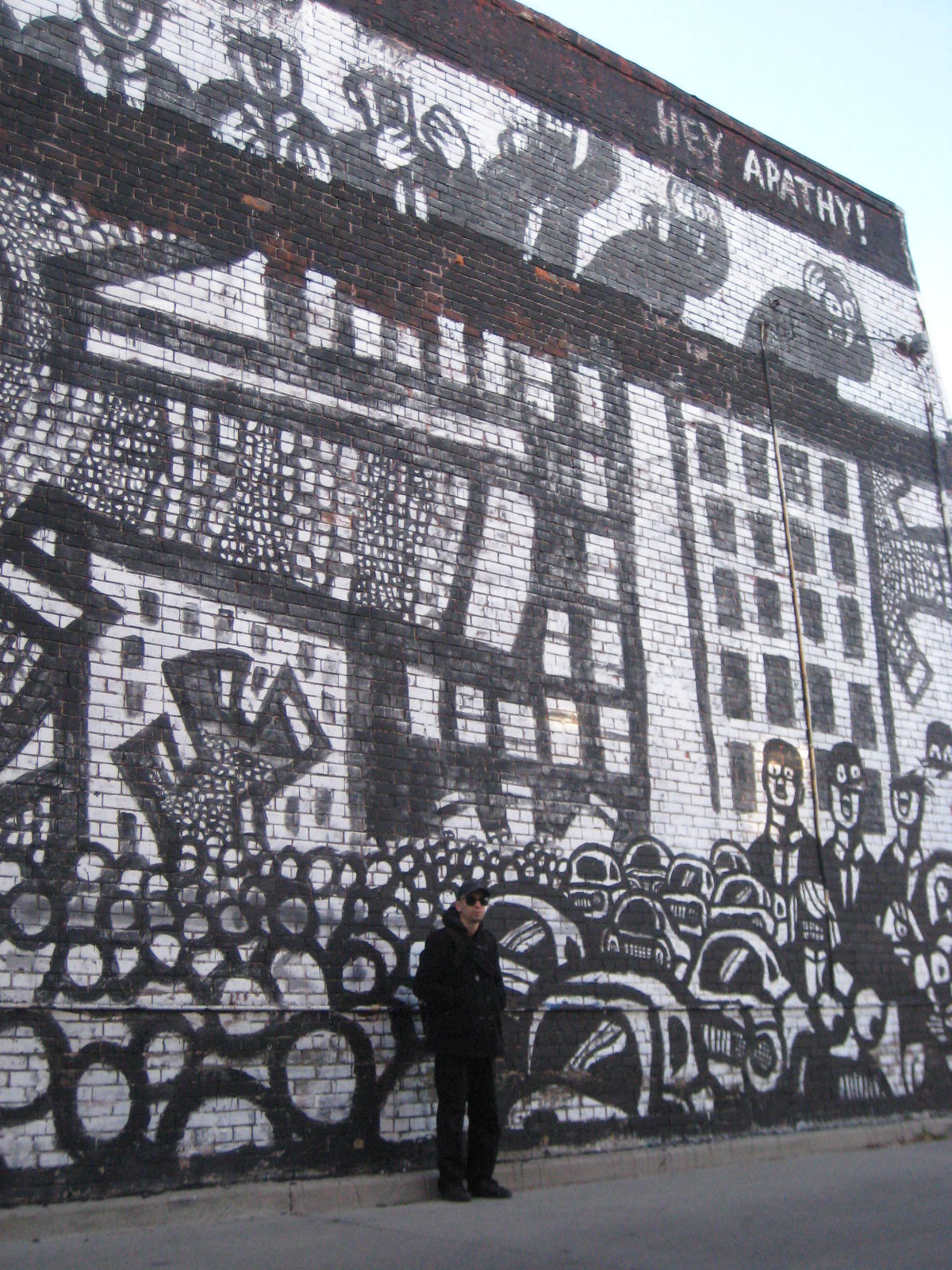
In an alleyway near Queen and Bathurst streets, Toronto artist Mike Parsons stood in front of a giant mural. What was once a brick wall had become a canvas for his artwork.

"This was a huge process,” Parsons said. “The first thing was priming the wall white, which I did with giant poles.”

Hired by the owner of the house with the brick wall, Parsons created the mural using a 40-foot ladder and a few hundred dollars worth of white and black paint. He worked his way across the wall, section by section.

“I basically would paint about 40-by-five-feet a night,” he said. “It took about 40 nights in total to complete.”

Over the last decade, Parsons, who works under the name Hey Apathy!, has completed three graphic novels and over 10 major gallery installations. He’s also done numerous public wall murals and street art performances.

He explained why he prefers street art over gallery work.

“The commercial side of the galleries could get a bit trying; they would tell you what to do, what size to paint, what to paint, and ask you to do more of what sold last year,” he said. “The streets were a way that I would have complete control and freedom over whatever I did.”

Eric Cheung, another Toronto artist and collaborator with art group AT.AW., sides with Parsons.

“When I have a gallery show, it’s very anti-climactic; you put it on the walls and a couple of people see it,” Cheung said, “(but on the street) if you have a good idea, you could just toss it out there … It’s not squirrelled away or hidden.”

Jack Cassady, an associate professor at the Ontario College of Art and Design, acknowledged some of the benefits that street art has over gallery work.

“It gives the artist an opportunity to experiment without pressure from public or commercial galleries,” Cassady said. “So they can be more individual; they get out their voice.”

Unlike Parsons, Cheung prefers to do street art without anyone watching. He often takes to the streets very early in the morning, posting textile images of his characters - dubbed The Orphans - on utility poles or plywood at construction sites.

“I like the fact that when you throw stuff on the street, it’s this idea of it being free,” he said. “If you associate it with somebody or some event … people start thinking about other motivations rather than simply this person just putting work on the street for you to enjoy.”

Matthew Blackett, publisher of Spacing magazine, supports the type of DIY street art that Parsons and Cheung do. He recalled a time when he was walking through Little Italy and noticed pieces of cardboard with fruit illustrations affixed to the lampposts.

“You could clearly see someone was doing this intentionally,” Blackett said, “for no other thing than just to catch the odd person’s attention and question what it was.”

Getting people’s attention is what Cassady said a street artist’s reputation depends on.

“The only way you’re going to get anything happening in the street art (culture) is if you draw attention,” he said. “If you don’t draw attention, nobody is going to notice you.”

Although Cheung says it’s great when people find out who he is and want to know more about his projects, he’s not trying to convey a political message.

"I'm just trying to create a more interesting urban environment," he said. "It's funny. In Toronto, the street art is always very much about a very political idea … There's a couple arguments I've had where it shouldn't be as demanding of a message as some people would like it to be."

Parsons has a different approach. As he walked around the gallery (at 401 Richmond St.) displaying some of his paintings, he described one of the common themes in his art.

“The idea is that the city is the gear and it's up to all the people to propel it,” he said. “If each person takes responsibility for their actions, then that's a good place to start … Even by not doing anything they have an effect.”

As a self-represented artist, Parsons promotes and sells his own artwork. He also built the website for his business from scratch.

He explained why he chooses to do all of the work himself.

“All of those are jobs that could be done by various people to make it work, but it can’t always be done the way that I want it to,” he said. “Instead, I pace myself and do it all myself and things end up being more rewarding that way.”

Monday, November 29, 2010

The DIY Bug is Gender Inclusive

Steve Smith (Red Green) had a 1999 Chrysler 300. Curiosity led him to see if he could turn his gas-guzzling sedan into a more energy efficient vehicle. Smith chose the DIY route.

“I built a hydrogen generator and put it under the hood,” Smith said. “I used that to augment the fuel supply and put a little device to fool the car computer so it leans out the gas mixture… It now gets almost 50 miles per gallon.”

At 15, Mag Ruffman attended camp on the “protected shores of Georgian Bay” (as the camp sign read) and eventually signed up for the Councellor-in-Training program. She remembers the minute the DIY bug bit her.

“I put up these hooks up (in the showers) with a hand-crank drill and a screwdriver,” Ruffman recalled. “I made a jewel out of it. That afternoon felt so good.”

With celebrity icons such as Red Green and Mag Ruffman offering instructions on TV, radio and books, the DIY bug has inspired both male and female handywork.

Curiosity and independence are factors that attract people to DIY, but how do men and women approach it differently?

Smith does everything for himself. His fans embrace his comedic acts and take his unique inventions and make them their own.

One of his most popular DIY projects consists of turning a modern designed plunger (with a second collar inside) upside down, sticking it into the ground and using the rubber piece as a beer holder.

“It fits perfectly,” Smith said. “I end up autographing plungers and some guys have made nameplates (for their plungers).”

Before Smith was signing plungers, he enrolled at the University of Waterloo for engineering. He found his calling during his first co-op term.

“I went to work at a place where I was doing everything,” Smith said. “Steam-fitting, machine welding, carpentry, electrical and plumbing, the whole deal.”

Nevertheless men and women learn and approach DIY differently. Ruffman said it used to be biological for women to expect the man of the house to take on the handy work at home. But as more women move into homes and condos on their own, the handy work falls to them.

Ruffman believes women are hard-wired to want comfort because they tend play a mothering role. Therefore, DIY culture demands she adapt and learn to be self-sufficient.

“For women it’s anti-status to do your own stuff. You have to be a bit of a maverick,” she said. “All of a sudden tools are becoming a status item. Many women have come up to me and told me ‘I bought my first drill. I have no idea what to do with it, but I have one.’”

Jennifer Hart meets men and women at trade shows and workshops organized by Lee Valley and Canadian Home Workshop. She takes beginner DIYers through baby steps while simultaneously challenging veteran woodworkers. Although her approach teaching men and women is identical, she notices distinct learning patterns.

“Women will ask way more questions. They don’t have a problem admitting their fear of the project,” Hart said. “Women will take the time to gather as much information as they can because it’s unfamiliar.”

Working with men, however, Hart said they just jump right into the project. If they hit a snag, they deal with it and move on.

“The end result may be the same; it’s just two different methods of getting there,” she said.

Smith recalled a time when a fan shared a story about turning his pull-start lawnmower into a riding mower. He hit a snag, but ended up with a Frankenstein machine.

It all started with the handle on his lawnmower, it kept breaking off. The man bought a riding-mower at a garage sale, but found out that the blade wouldn’t turn, rendering it useless.

“He fashioned a chain out of duct-tape and connected the handle on his push-mower to the back of his riding-mower. Now he tows the push-mower to cut his lawn,” Smith said.

Mag Ruffman helping a fellow lady DIYer at a Home Depot in Vancouver

This example illustrates the fearless men have in their DIY endeavors. It is this fearlessness that gives men somewhat of an advantage over female DIYers.

Ruffman said fear often deters women from DIY projects. She said she enjoys playing the role of a den-mother for a whole generation of women looking to master the home they just bought.

“It’s a frontier available to everybody. It’s a fabulous form of self-expression,” Ruffman said.

For Smith, turning to DIY is more than an expression of gender. It’s his method of avoiding the most horrible feeling a human can feel, helplessness.

“When you feel helpless and you’re in somebody else’s hands and you can’t move forward and that’s very frustrating,” Smith said.

Steve Smith and Mag Ruffman at the Hamilton Marina where they worked on Smith's autobiography together.

Highlights from Red Green Interview


Dedicated fan, doing it the way Red would


So Red, have you done all these projects you talk about?


How much of Red Green is in Steve Smith?


What Red Green does with a Cadillac!!


Steve Smith has his limits


Red's Worst Emotion!


Spreading the Disease...Recyling Lessons in DIY

Between taking apart his toy trains as a child, and renovating his family’s cottage as an adult, Thomas Sands has been a part of do-it-yourself (DIY) projects all his life. His DIY life drew him to Bike Pirates where volunteering and learning go hand in hand.

“Half of it here is people taking things apart, screwing it up and learning from it then fixing it,” Sands said.

Located in what Sands calls a “bohemian” part of the city, Bike Pirates at 1292 Bloor St. W. is a volunteer bike shop where cyclists come to work on their bikes or purchase parts and accessories in return for a donation.

Thomas Sands in the pirate dungeon amongst an enormous collection of recycled bike parts


Geoffrey Bercarich volunteers for Bike Pirates and over his four years, he’s seen how the community helped keep the shop afloat.

“It’s co-operative, people have a vested interest,” Bercarich said while sorting through a pile of handle-bars. “Somebody can have this for a money donation and it goes right to the operational costs.”

Depending on how much is used, borrowed and blue, Bike Pirates help people who walk in empty handed, walk out with a functional bicycle.

Customers have three options; fix their bikes, buy a refurbished bike for a donation, or build a bike from scratch.

After working with various professional repair shops, Sands started volunteering with the pirates over two years ago. He believes the DIY space gives cyclists an opportunity to learn about their bikes and an opportunity to be less dependent on repair shops.

“(Customers) are learning about their own bike and in the future they’ll be more empowered because they know how it works and they can fix it on their own,” he said.

Derek Laventure walked into Bike Pirates with a new bike frame. He gathered various parts around the city and Bike Pirates offered him guidance, space and the tools necessary to turn a frame into a bike.


Derek Laventure DIYing at Bike Pirates


“I knew I could do basic maintenance,” Laventure said. “But the project of building something from scratch was appealing.”

Laventure said his curiosity motivated him to learn more about his simple machine. He believes without a collective like this, his project would be more challenging.

“We call it do-it-yourself, but we’re actually working together,” he said.

Tony Reilreino walked into Bike Pirates with the vision of piecing together a “beater” for winter. Rummaging through the shop’s enormous parts collection, he’s using Bike Pirates to build a bike the green way.

“It all falls into the whole (environmental issue), buying these parts which are picked by hand here and aren’t bikes assembled in China,” he said. “It’s nice knowing you’re not driving around in a car and adding to the smog and pollution.”

Bike Pirates also promotes its money-saving qualities. Volunteers agree economy is the most attractive aspect of the shop. Others come in to feed their curiosity.

“Some aren’t here to save money because some people donate way more money than we would ask for,” Sands said. “Some come here because they like the concept and life-learning and they appreciate the space.”

Giles Alder from the Urbane Cyclist started repairing old bikes as a hobby. Then turned it into a business. He’s realized how expensive repairs can be so riders turn to his bike shop for a quick fix and a warranty.

“I find that people have time and no money, or they don’t have time and have money,” Alder said. “A lot of our clientele don’t care and can afford to have someone else fix their bike.”

Alder also lends a hand at these DIY bike shops by donating parts. He believes the more people he helps get on bikes, the more customers he’ll have in the future.

“If they get more into bikes, when they can afford to upgrade, they’re going to go to a shop to get better parts and a warranty.”

Whether it’s a commercial or DIY bike shop, mechanics and volunteers agree getting people out of their cars and onto bicycles is a move towards sustainable living.

“People volunteer (at Bike Pirates) because they like contributing to the community… and they support the project and they like helping people because it’s a productive hobby,” Sands said.

Goin' Guerrilla

Sean Martindale found a lamp post at the corner of Queen and Spadina streets. It inspired him to deliver something special to the community: a pocket plant carved out of posters pasted and cluttering the post.

“I wanted to put up a plant in a way that people would recognize that it wasn’t supposed to be there,” Martindale said.

There are gardeners looking to break the mould, so they look to the cityscape for opportunities to beautify neglected spots of Toronto. Martindale and his friend Eric Cheung are guerrilla gardeners. What began as street art, soon became an inquiry into the uses of public space. With a pair of scissors and some staples, Martindale can turn any poster advertisement into a planter. In his view, this is a more positive use of public space.


Photo provided by Sean Martindale


Since last summer’s inauguration of the Pocket Plant Project on the Queen street. light post, Martindale and Cheung have expanded there gardening spots. Where traditional guerrilla gardeners concentrate their work on beautifying established green spaces, Martindale looks to make the streets a little greener.

“I am deliberately growing over these illegal ads and showing that space can be used differently,” he said.

The posters that clutter the city have led Martindale to plan an intricate layout for his pocket plants.

“The planter is a cone-shape, with the base slightly open, so when we water the plants the water drips down through the bottom and it would go into the next pocket,” he explained.

Martindale avoids cutting through community posters or public service announcements, because he feels those are positive uses of public space. He’s concerned with aggressive companies that post up the same promotional poster all over the city. This led Martindale to start planting covertly.

“Our point was to try and avoid crowds and go at the break of dawn when there weren’t that many people around,” Martindale said. “But we found that people have been supportive of this project. Plants are something positive and it’s something people like to see in their environment.”

Barry Parker, a horticulturalist with the Toronto Rock Garden, agrees

“I’m very for the idea of guerrilla gardening, but I’m not impressed,” he said.

Parker has noticed many signs around guerrilla gardens that say “water me,” an anthropomorphic attitude towards gardening that he says is superficial.

“Gardening involves patience, commitment and ongoing cultivation,” he said.
Parker also doesn’t like the fact that most guerrilla gardeners are planting exotic plants, because eventually they turn into mush.

Martindale recognizes the environmental issues involved with bringing in an unknown species.

“We try and avoid invasive species or anything that would have a chance to spread outside of our planters,” he said.


Because his pocket plants are ephemeral spots, his team looks for native plants that are cheap and hearty. They work aesthetically and won’t cost him an arm and a leg.

His team’s initiative to take guerrilla gardening to the street, coupled with his creative strategies for making the city greener, highlights his DIY mentality.

“We kind of taught ourselves over the course of it. We’ve seen what plants survive best and which ones are most supportable,” he said.

With these pocket plants blooming all over Toronto, Elyse Parker, who’s been the director of Transportation Services in the Public Realm at Toronto City Hall since 2009, is humbled by the fact that people care about their public space and take interest in planting flowers and looking after them.

“Guerrilla gardening may have been an issue in the past. It’s certainly not now. Since the city put a new focus on improving the public realm, there’s been a lot of support,” she said.
Her only concern is that these street plants aren’t poisonous and don’t block a driver’s sight lines.

Once Martindale gauged the support level from the community, his approach to guerrilla gardening became more participatory. He wants the community to join in. This is why he chose to take his work to the streets and not city gardens.

This motivation to get groups involved stems from his psychology and how he became involved with guerrilla gardening.

“For me it was a desire to participate and take a more active role in my own environment and try to encourage others to do the same.” Martindale said.

“When there’s more engagement and more people taking an active role, I think our environment becomes more interesting and dynamic.”

Monday, November 22, 2010

SOLO CANOE TRIPPIN': Alone in the wilderness

Clairissa Carter remembers how scared she felt the night of her first solo canoe trip in the summer of 2001.

“I was kind of freaked out,” Carter said. “I ended up going to bed pretty early and slept with a little hatchet beside my head, waking up at every sound and noise that I heard.”

Since that night near Ragged Lake in Algonquin Park, Carter has become more adapted to sleeping alone in the woods. She has completed over 20 different solo wilderness treks. She’s hiked the snowy mountaintops of Nunavut and New Zealand and she’s camped in the Borneo jungle in Southeast Asia.

Carter described how she has progressed as a solo tripper.

“When I first started, I brought a lot of comfort stuff ... Lots of food and one of those foam collapsible chairs,” she said. “But nowadays, the last time I did a solo in Algonquin, I didn’t even bring a tent with me; I just brought a tarp and I slept underneath my canoe.”

Matt Howell, adventure director at Missinaibi Headwaters Outfitters in Chapleau, Ont., finds that talking to people about their intentions is the first step towards a successful solo trip.

“The best question that we ask people is, ‘What do you want to get out of your trip?’” Howell said. “If one of those things … is to be comfortable on their own and to face that challenge, then are they in the right mindset to face it.”

Ecopsychologist Betsy Perluss, who leads wilderness programs with the School of Lost Borders in California, echoed Howell's approach.

"Being alone in the wilderness triggers a lot," Perluss said. “You're susceptible to all kinds of ideas and feelings and thoughts that perhaps one would rather avoid."

Carter can relate. A solo hike in the Ruahine Mountains of New Zealand - a trip she expected to be a relaxing getaway - unexpectedly served a greater purpose.

"When I started walking up there, it got a lot tougher than I thought," she said. "It was a harder climb and there were more obstacles in the way. Then the snow started falling and it was getting colder and it just brought out a lot of anger in me.”

By the end of the trip, she realized the meaning of her anger.

"I hadn't really got past the death of a friend of mine," she said.

Her friend had died back home in Canada while she was in New Zealand. Not being able to grieve with her friends and say goodbye to him took its toll.

"I bottled it up ... I'd really locked it away to such a point that I'd sort of forgotten about it," she said. "I dealt with those emotions and I was able to make peace with that.”

At the School of Lost Borders, Perluss often sees people coming to terms with personal struggles.

“Being in a world full of so many distractions, it takes time to begin to peel away the layers and to get to the core of oneself,” she said. “That can be painful at first.”

When it comes to why some people prefer to be alone, Perluss said it’s a matter of personality.

“Some people really find their energy and juice from being around others,” she said. “Some people much prefer, just by their temperament, to be alone.”

When going alone on an outdoor adventure, Howell listed a few items that trippers sometimes forget: Fire-starter for wet wood, a bear banger, a satellite phone and a first aid kit.

Howell acknowledged another problem solo trippers overlook on a wilderness canoe trip.

“A lot of people overestimate their abilities,” he said. “Trying to advance your abilities is not necessarily what you should be doing on solo trip.”

Although Carter has paddled Smoke Lake in Algonquin Park numerous times, one time, a severe storm nearly forced her to give up.

“The rain was pouring down; it was freezing cold ... The wind was so strong that for the most part I was losing ground," she said.

But she had friends waiting to meet her at the other end of the lake and she knew they would worry if she didn’t show up.

"That's probably the closest I've come to hypothermia," she said. "When I got to (my friends) I was uncontrollably shivering. They threw me in the shower and brought me hot cups of tea."

One of the hardest nights for Carter happened in the Borneo jungle after she ran out of water and drank from a nearby stream.

That night, she battled severe stomach illness along with fever and hallucinations.

To add to her confused state of mind, she woke up the next day to find bearded pigs gnawing at her backpack.

“I didn’t even know they existed,” she said.

But they do - and they were hungry.

“I had granola bars or something in the backpack, so they were just trying to bite at it and stomp at it,” she said. “I had to grab my backpack and pull it away from them.”

Among her many ordeals, Carter has also had some enlightening experiences.

A few days before the bearded pig incident, an orangutan was foraging amidst the trees nearby. She inched her way closer to the wild animal, sat beneath the tree and enjoyed a moment near the animal.

“Life seemed so simple; it was just eating fruit from a tree, there was no packaging,” she said. “Nothing other than pure nature.”