Showing posts with label diy. Show all posts

Friday, December 10, 2010

Goin' social through song and axe

It's pouring rain in Matt Wilson's backyard.

About 40 people have come to battle the damp and chilly October night, all in the name of Wilson’s game: Backyard Axe Throwing League (B.A.T.L.).

Players step up to a stone plate, wield their individually painted hatchets behind their heads and aim for the bull’s-eye on a rectangular-shaped wood plank target 15 feet ahead.

“It’s satisfying as all hell; the sound it makes and the feeling you get when you throw it and it sticks in the bull’s-eye,” Wilson said. “Then you just want to throw five in a row.”

But not everyone has come to throw an axe. Half of the people there want the entertainment.

“It’s totally a social thing,“ Wilson said. “When you’re not playing, you’re hanging out and you’re watching and you’re cheering.”

A similar social element exists in Toronto’s do-it-yourself acappella singing group, Tunes Beats Awesome (TBA).

‘Have fun. Sing good.’ That’s TBA’s mantra.

Eight years ago when it began, Jeff Magee started singing with TBA; he’s since become co-director of the group.

Every Sunday, Magee drives from Pickering to the Hart House building at the University of Toronto campus to meet with the other 17 group members for rehearsal.

Magee conducts each rehearsal, coaching the singers and giving them feedback. When TBA performs at events such as Acappellooza - where they gave two sold-out shows last year - he joins the group on stage to provide the vocal percussion.

When they’re not rehearsing, Magee and co-director Katherine Dodds have their hands full running the group.

“TBA’s not just a Sunday-run group,” Magee said. “You have to be thinking about everything every single day.”

Printing off sheet music, booking gigs and directing their publicity keep Magee and Dodds occupied. Although Magee finds it tiring, the reaction he sees from the singers makes it all worthwhile.

“You get a lot back from it just seeing how much they enjoy it,” he said. “I wouldn’t put the effort in if I didn’t feel it was rewarding.”


Clips from B.A.T.L. featuring TBA's version of "Battlefield"

Wilson’s B.A.T.L. began while on a cottage trip in the summer of 2006. Wilson and his friends started throwing a hatchet into a tree to pass the time. They soon added rules and a point system. Five throws per player per round, three rounds per set. Players get five points for the bull’s-eye, three points in the ring around it and one point for the outer ring. The player with the most points wins the round as they play a best-of-three set.

When Wilson returned home from the cottage trip, he built the first B.A.T.L. target and convinced a dozen friends to contribute $25 for materials and to join the fun.

Since then, B.A.T.L. has continued to grow in popularity. This year has been particularly significant for Wilson.

“I took the plunge to make it two nights (per week) and did all of the legal stuff to make it completely legitimate,” he said. “I’m now treating it like something that I could do for a living, within the next year maybe.”

Wilson plans to eventually move the league indoors and run it year-round. He explained why he thinks the game attracts competitors.

“There’s an element for people who feel like they shouldn’t be allowed to do it,” he said. “You’re throwing an axe ... It sounds completely dangerous, but when you get back there and see it, it’s not at all; it’s totally organized.”

David Banerjee, a Toronto teacher with an MA in educational theory, explained why people engage in activities outside their daily work routine.

“We have a minimum amount of social intercourse that we need,” Banerjee said. “We are pleasure-seeking ... We like to be around each other. We’re evolved for tribal living and it’s nice to have fun.”

Banerjee added that people have been designed to find meaning in the world by doing something they enjoy.

“People structure their understanding of the world by saying, ‘I’m not really going to try and understand the world, I just want to understand my little piece of it ... and I’ll be pretty happy,’” he said.

Sharing that understanding with others appears to be a common theme for TBA and B.A.T.L. participants. Just like Wilson said, Magee finds value in the social aspect of acappella singing.

“Some of the best times we have are when we go to Michigan and meet other groups,” Magee said. “It’s like a family ... You’re all music nerds.”

Wednesday, December 1, 2010

Toronto artists do it on the street


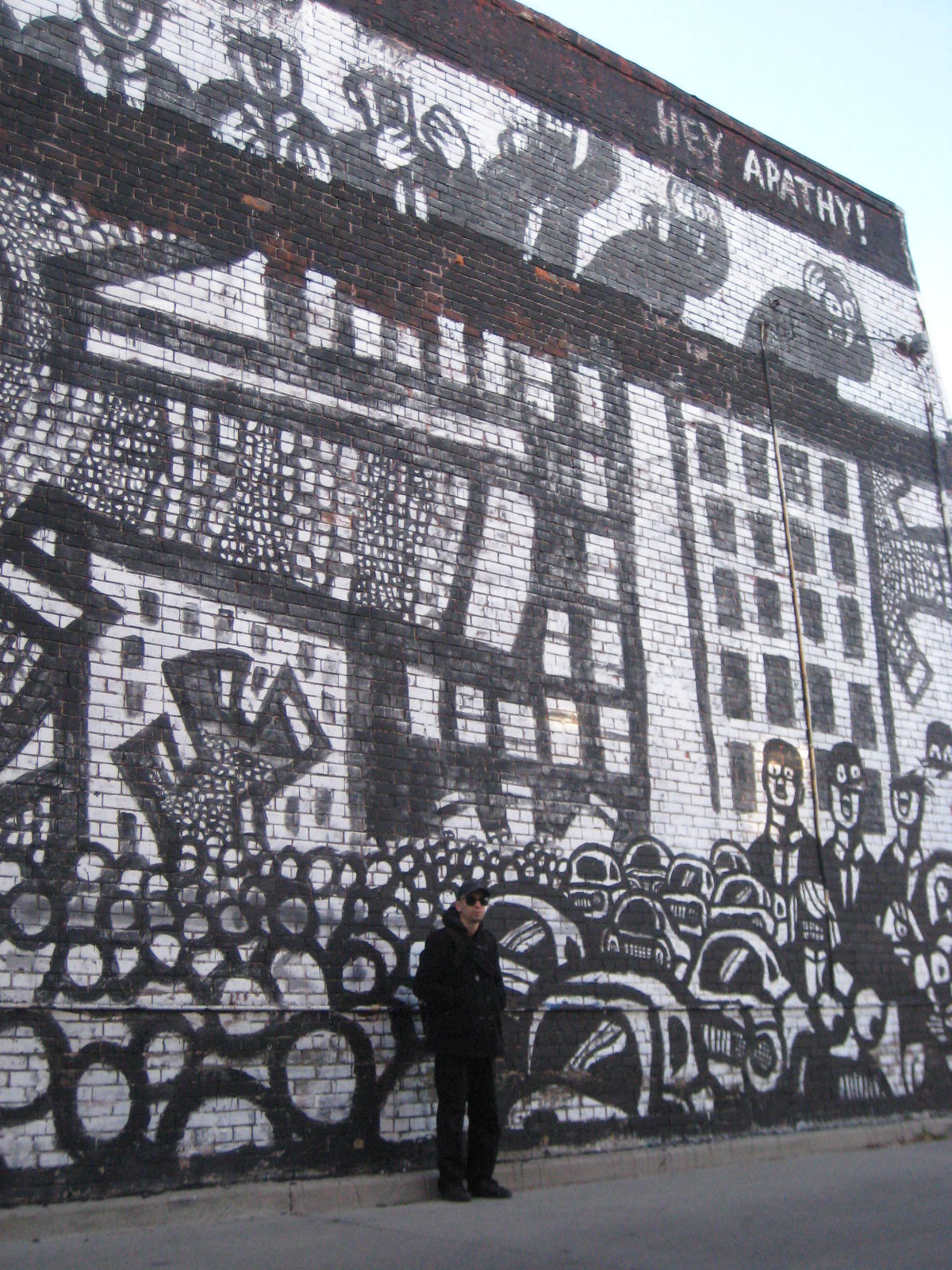
In an alleyway near Queen and Bathurst streets, Toronto artist Mike Parsons stood in front of a giant mural. What was once a brick wall had become a canvas for his artwork.

"This was a huge process,” Parsons said. “The first thing was priming the wall white, which I did with giant poles.”

Hired by the owner of the house with the brick wall, Parsons created the mural using a 40-foot ladder and a few hundred dollars worth of white and black paint. He worked his way across the wall, section by section.

“I basically would paint about 40-by-five-feet a night,” he said. “It took about 40 nights in total to complete.”

Over the last decade, Parsons, who works under the name Hey Apathy!, has completed three graphic novels and over 10 major gallery installations. He’s also done numerous public wall murals and street art performances.

He explained why he prefers street art over gallery work.

“The commercial side of the galleries could get a bit trying; they would tell you what to do, what size to paint, what to paint, and ask you to do more of what sold last year,” he said. “The streets were a way that I would have complete control and freedom over whatever I did.”

Eric Cheung, another Toronto artist and collaborator with art group AT.AW., sides with Parsons.

“When I have a gallery show, it’s very anti-climactic; you put it on the walls and a couple of people see it,” Cheung said, “(but on the street) if you have a good idea, you could just toss it out there … It’s not squirrelled away or hidden.”

Jack Cassady, an associate professor at the Ontario College of Art and Design, acknowledged some of the benefits that street art has over gallery work.

“It gives the artist an opportunity to experiment without pressure from public or commercial galleries,” Cassady said. “So they can be more individual; they get out their voice.”

Unlike Parsons, Cheung prefers to do street art without anyone watching. He often takes to the streets very early in the morning, posting textile images of his characters - dubbed The Orphans - on utility poles or plywood at construction sites.

“I like the fact that when you throw stuff on the street, it’s this idea of it being free,” he said. “If you associate it with somebody or some event … people start thinking about other motivations rather than simply this person just putting work on the street for you to enjoy.”

Matthew Blackett, publisher of Spacing magazine, supports the type of DIY street art that Parsons and Cheung do. He recalled a time when he was walking through Little Italy and noticed pieces of cardboard with fruit illustrations affixed to the lampposts.

“You could clearly see someone was doing this intentionally,” Blackett said, “for no other thing than just to catch the odd person’s attention and question what it was.”

Getting people’s attention is what Cassady said a street artist’s reputation depends on.

“The only way you’re going to get anything happening in the street art (culture) is if you draw attention,” he said. “If you don’t draw attention, nobody is going to notice you.”

Although Cheung says it’s great when people find out who he is and want to know more about his projects, he’s not trying to convey a political message.

"I'm just trying to create a more interesting urban environment," he said. "It's funny. In Toronto, the street art is always very much about a very political idea … There's a couple arguments I've had where it shouldn't be as demanding of a message as some people would like it to be."

Parsons has a different approach. As he walked around the gallery (at 401 Richmond St.) displaying some of his paintings, he described one of the common themes in his art.

“The idea is that the city is the gear and it's up to all the people to propel it,” he said. “If each person takes responsibility for their actions, then that's a good place to start … Even by not doing anything they have an effect.”

As a self-represented artist, Parsons promotes and sells his own artwork. He also built the website for his business from scratch.

He explained why he chooses to do all of the work himself.

“All of those are jobs that could be done by various people to make it work, but it can’t always be done the way that I want it to,” he said. “Instead, I pace myself and do it all myself and things end up being more rewarding that way.”